
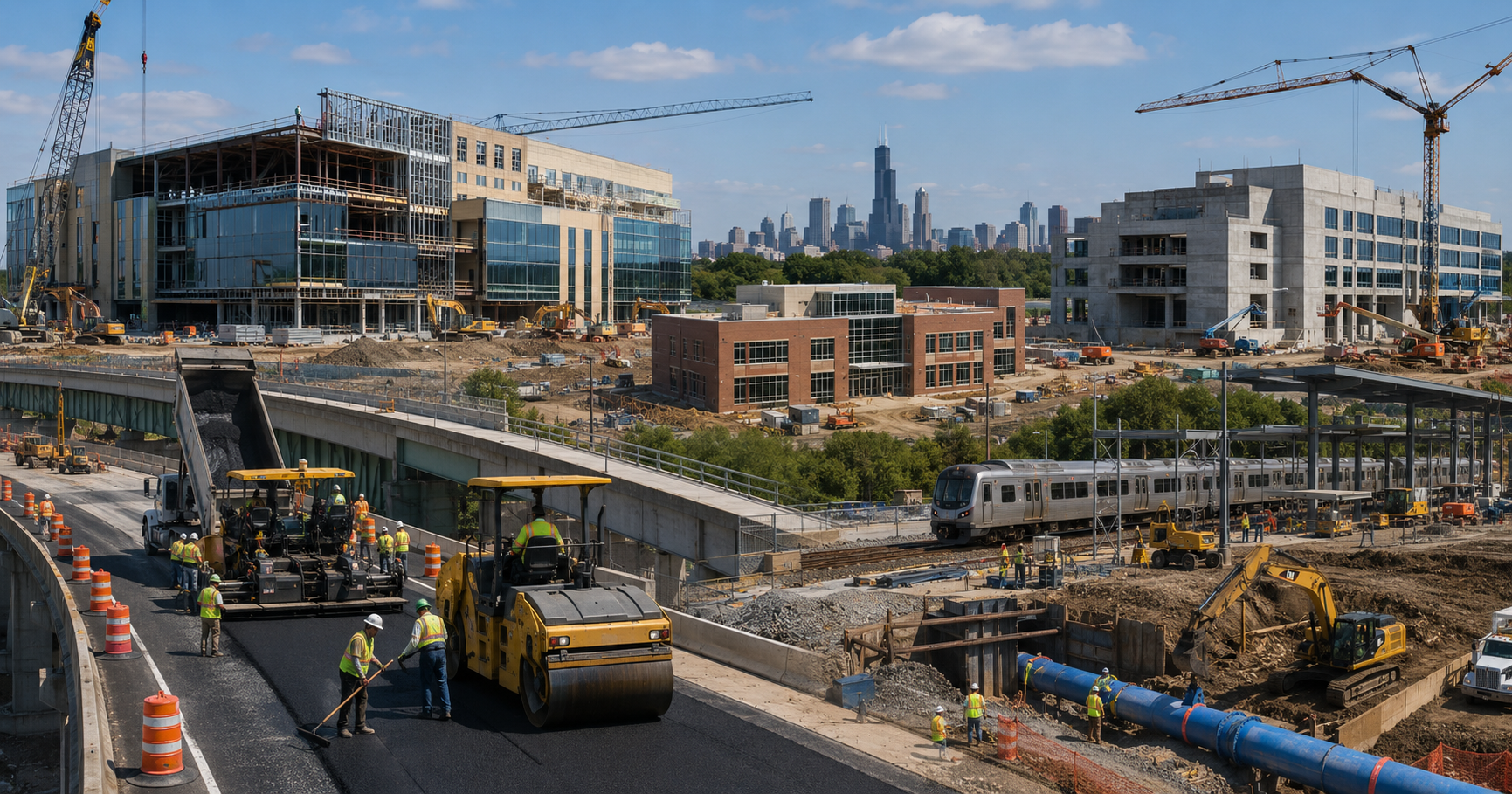
Where Money Is in Illinois Construction in 2026: Public Work by Sector
Private commercial work in Illinois has gotten harder to pencil. Office is still soft, competitive bid pricing has flattened in Chicago even while input costs climb, and more firms are chasing the same shrinking list of private jobs. If your backlog looks thinner going into the back half of 2026 than it did a year ago, you are not imagining it and you are not alone.
The public side tells a different story. Illinois has an unusually deep and unusually visible pipeline of publicly funded construction right now, and much of it is programmed years out. That matters because public work is the one part of the market where you can see the money before the job hits the street.
Here is where that money actually sits in 2026, sector by sector, and what it takes to get near it.
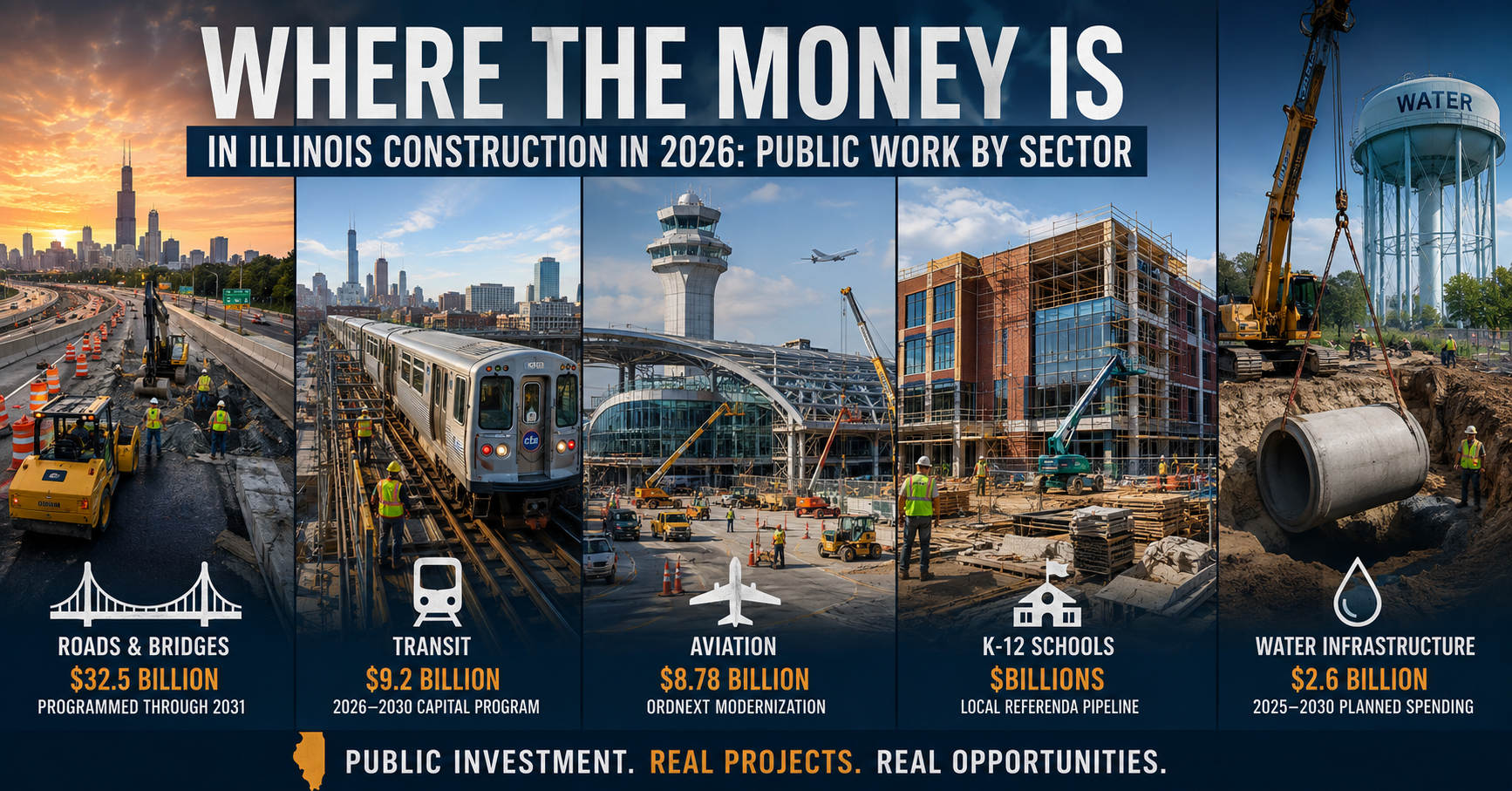
1. Roads and bridges: $32.5 billion programmed through 2031
IDOT's FY 2026 to 2031 Multi-Year Program for Roads and Bridges commits $32.5 billion over six years. Of that, $25.7 billion goes to the state system and $6.8 billion to the local system. The program targets 7,107 lane miles of road and 8.4 million square feet of bridge deck to be improved or built.
The state system breakdown is roughly $10.6 billion for roads, $7.9 billion for bridges, $2.2 billion for safety and system modernization, $2.6 billion for system expansion and $2.4 billion for system support.
This is fueled by Rebuild Illinois, the $45 billion capital plan passed in 2019. As of September 2025, Rebuild Illinois had awarded $20.8 billion in projects covering 21,309 lane miles of road improvements, 815 bridge projects and 1,181 safety improvements. Statewide, Illinois has spent roughly $28 billion from capital appropriations since fiscal year 2020.
What this means for you: the horizontal pipeline is programmed, not hypothetical. IDOT publishes the multi-year program by district, so you can see what is coming in your county before it is let. If you are not IDOT prequalified, that is the gate, and it is worth clearing even if you only intend to sub.
Trades pulled in: earthwork, paving, structures, drainage, guardrail, signals, lighting, striping, trucking and aggregate supply.
2. Transit: the fiscal cliff is gone and $9.2 billion in capital is on the table
This is the single biggest change in the Illinois public market in the last year, and a lot of contractors still have not registered it.
For two years the story out of Chicago transit was service cuts and a funding cliff. That ended on December 16, 2025, when Governor Pritzker signed Senate Bill 2111, the Northern Illinois Transit Authority Act. The law generates roughly $1.5 billion annually, including an estimated $1.2 billion in new annual operating funding for CTA, Metra and Pace. It takes effect in June 2026 and converts the RTA into the Northern Illinois Transit Authority.
Two days later, on December 18, the RTA board adopted a 2026 operating budget of $4.352 billion and a 2026 to 2030 Regional Capital Program of $9.246 billion, with no fare increases and no service cuts.
What this means for you: an agency staring at a deficit defers capital. An agency with stabilized operating revenue and an adopted five-year capital program lets work. Station rehabs, track and structure, signals, power, bus facilities, yards, elevators and ADA work all sit inside that $9.2 billion.
Trades pulled in: concrete, structural steel, electrical and traction power, signal and communications, mechanical, elevator, roofing, glazing, finishes and specialty rail contractors.
3. Aviation: ORDNext is an $8.78 billion program in active construction
O'Hare is not a future opportunity. It is under construction now.
ORDNext is the City of Chicago's $8.78 billion modernization of O'Hare's core facilities, the next phase of the O'Hare 21 program. The first major piece is the new 19-gate Concourse D. In June 2026 the Chicago Department of Aviation finalized a Guaranteed Maximum Price of $1.455 billion with lead contractor AECOM Hunt Clayco Bowa, roughly $21 million under the approved budget, less than a year after construction started. The O'Hare Global Terminal, the $2.2 billion replacement of Terminal 2, follows.
What this means for you: programs this size run for a decade and rebid packages continuously. The prime team is set on Concourse D, but the sub and supplier packages under it are not a one-time event. O'Hare work also carries meaningful MBE, WBE, veteran and disability-owned participation requirements, which is a real advantage if you hold a certification and a disadvantage if you have been meaning to get one for three years.
Trades pulled in: essentially all of them, plus airport-specific specialties like baggage handling, jet bridges, apron paving and airfield electrical.
4. K-12: local referenda are the sleeper pipeline
School work does not show up in a state capital plan. It shows up on a ballot, and then it shows up in your market 12 to 30 months later.
The March 17, 2026 Illinois primary was a live demonstration. Ball-Chatham School District voters approved a $110 million referendum for infrastructure and safety upgrades, driven in part by failing boilers, water lines and electrical service. Sunset Ridge District 29 in Northfield passed a $23.5 million bond for a major overhaul of Middlefork School by a two to one margin. In St. Clair County, voters approved a $75 million school bond. Yorkville District 115's $275 million proposal failed, and the district has signaled it will return in November with a smaller package, likely trimmed by at least $60 million.
What this means for you: a passed referendum is a bid list you can get on before a single drawing is issued. A failed one that is coming back downsized is a second chance with a known scope. Watch the November 2026 general election ballot closely, because that is where the next wave gets decided.
Trades pulled in: HVAC and boiler replacement, electrical service upgrades, roofing, masonry, plumbing and water line replacement, site work, athletics and additions.
5. Water and wastewater: driven by a legal deadline, not a budget cycle
Water infrastructure work in Illinois has a forcing function that most sectors do not have: a statutory replacement mandate.
Under the Illinois Lead Service Line Replacement and Notification Act, community water supplies must inventory their lead service lines and replace them on state-set schedules. The result is hundreds of municipalities applying for Illinois EPA loan funding at the same time. Homewood, as one example, held a public hearing in March 2026 on its IEPA loan application to replace 4,363 lead service lines by 2036.
The funding channel is the Illinois EPA State Revolving Fund, which runs the Public Water Supply Loan Program and the Water Pollution Control Loan Program. Illinois EPA publishes an Intended Use Plan every fiscal year with a project priority list, and the FY 2026 plan is public.
What this means for you: the project priority list is effectively a leading indicator of municipal utility bidding. Communities that show up on it are lining up financing, and financing precedes design, which precedes bid.
Trades pulled in: underground utility, directional drilling, excavation, restoration, concrete flatwork, plumbing, pipe and fitting supply, and traffic control.
6. State facilities, higher education and everything else in the capital budget
Beyond transportation, the Rebuild Illinois framework and the annual state capital budget fund state facilities, university and community college projects, environmental and conservation work, healthcare and human service facilities, and broadband. These are administered largely through the Capital Development Board rather than IDOT.
CDB work has a different rhythm than IDOT work. Appropriation does not equal advertisement. Money can sit appropriated for a year or more before a project is designed and let. The contractors who do well here are the ones tracking the appropriation, not waiting for the ad.
What this means for you: if you are only watching bid advertisements, you are seeing the last 5 percent of a process that started 18 months earlier.
If you have never bid public work, start here
Plenty of Illinois contractors have built a good business entirely on private and negotiated work. Public bidding is not harder, but it is more procedural, and the paperwork is where most first attempts die. The practical on-ramp:
-
Get prequalified where it is required. IDOT prequalification is its own application with financial statements and equipment schedules. Start it before you need it, not after you find the job.
- Line up bonding capacity. Most public work over threshold requires a bid bond and a 100 percent performance and payment bond. If you do not have a surety relationship, that is step one, not step four.
- Understand prevailing wage. The Illinois Prevailing Wage Act governs wages on public works, and it now reaches further than it used to. Public Act 104-0004, effective August 14, 2025, extended prevailing wage requirements to certain federally funded projects administered by an Illinois public body. Certified payroll is filed monthly through the Illinois Department of Labor portal.
- Get your certifications if you qualify. MBE, WBE, veteran-owned, disability-owned and DBE certifications materially change how much of the O'Hare, CTA and IDOT pipeline is reachable for you.
- Register on the portals. IDOT, Illinois BidBuy for state agency purchasing, CDB, and the individual municipal, county, school district and university sites. There is no single list, which is exactly why so many jobs go out with a thin bidder pool.
That last point is worth sitting with. The reason public work is often less crowded than it should be is not secrecy. It is fragmentation. The money is published. It is just published in 40 different places, on 40 different schedules, in 40 different formats.
Where DataBid fits
Tracking the funding is one job. Catching the projects as they move from appropriation to planning to design to bid is another, and it is the part that eats an estimator's week.
DataBid tracks Illinois projects across all stages, public and private, so the school addition that passed in March shows up in your feed when it goes to design rather than when the ad hits. It also carries the company data behind those jobs, 145,000-plus Illinois general contractors, subcontractors and suppliers, so you can see who is bidding what and get on the right lists earlier.
The short version
Private work is competitive and pricing is tight. Public work in Illinois in 2026 is the deepest, most visible pipeline in the market: $32.5 billion programmed for roads and bridges through 2031, $9.2 billion in regional transit capital now that the funding cliff is resolved, an $8.78 billion airport program in active construction, a fresh round of school referenda converting to design, and a legally mandated water replacement wave with dedicated state loan funding behind it.
The money is not hiding. It is just spread across more agencies than any one person can watch.
Want to see the Illinois pipeline in one place? Start a 5 day free trial or book a demo.
Jim Lamelza
Founder & CEO