
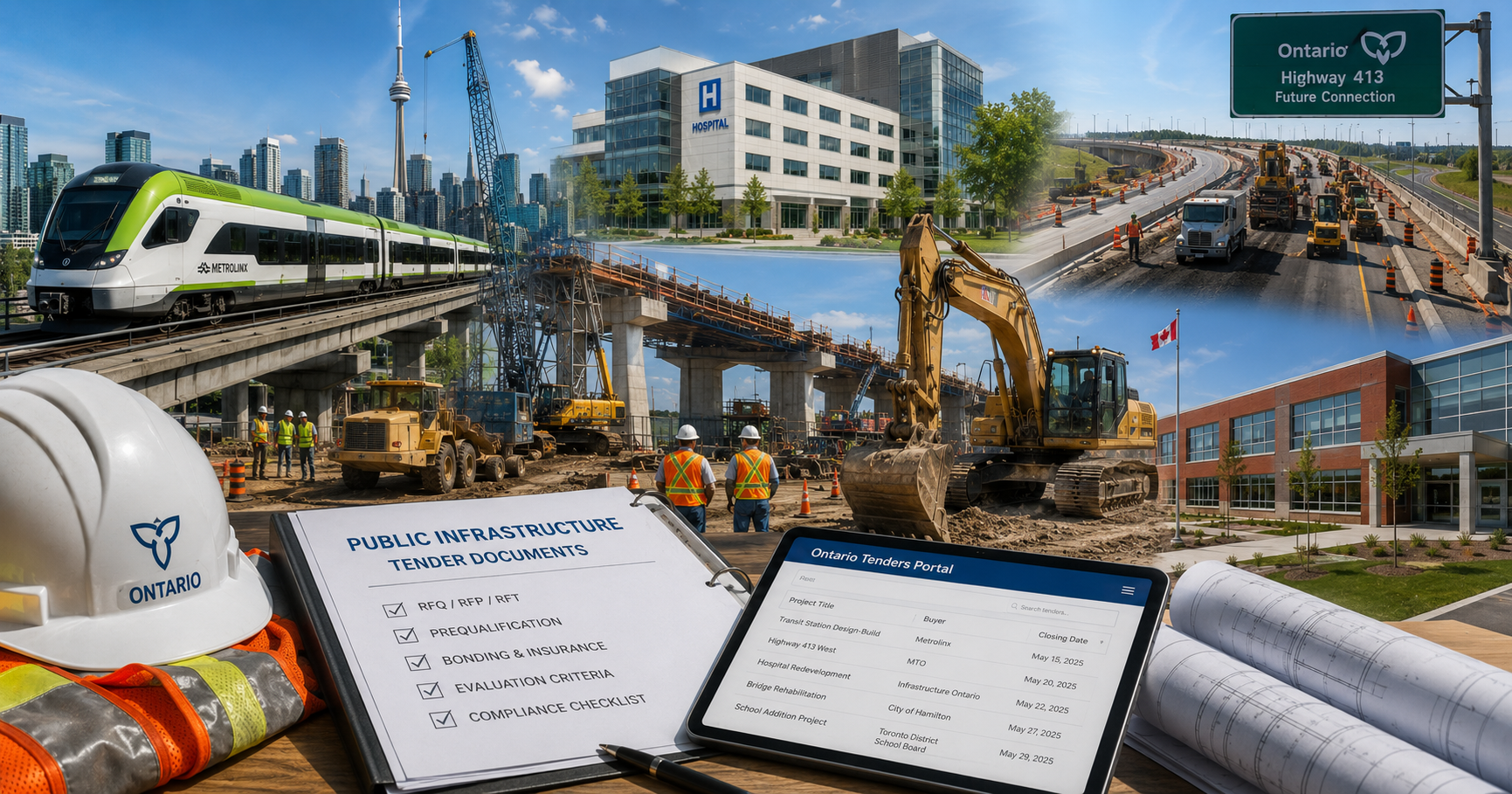
The Contractor's Guide to Ontario Public Infrastructure Tenders
Ontario is in the middle of the largest public infrastructure build in its history. Over $190 billion is committed across the next decade for transit, highways, hospitals, schools, and broadband. The opportunities are real, but the system that hands them out has its own rules, its own portals, and its own vocabulary. Contractors who learn it win work. Contractors who don't keep losing bids to firms that aren't actually better, just better prepared.
This is a working guide to that system: who runs it, where the tenders live, how a bid moves from posting to award, and what gets you disqualified before anyone reads your price.
The four agencies you need to know
Most public infrastructure dollars in Ontario flow through a small number of buyers. If you understand how each one buys, you understand 80% of the market.
Infrastructure Ontario (IO)
IO runs the province's largest projects through its Public-Private Partnership model (now branded AFP, Alternative Financing and Procurement). Think hospitals, courthouses, long-term care facilities, and the civil packages on the biggest transit jobs. IO works with a short list of pre-qualified consortia, so most subcontractors reach IO work through a Tier 1 GC, not directly.
Metrolinx
Metrolinx is the buyer behind the Ontario Line, the Eglinton Crosstown, Hurontario LRT, Hamilton LRT, and the GO Expansion program. Metrolinx procurements range from multi-billion-dollar civil packages down to station fit-outs, signaling, and trackwork subcontracts.
Ministry of Transportation (MTO)
MTO buys highway work, bridge rehabilitation, and the 400-series expansions, including Highway 413 and the Bradford Bypass. MTO uses its own contractor prequalification system. Without it, you can't even submit on most jobs.
Municipalities and the Broader Public Sector (BPS)
Cities, regions, school boards, universities, hospitals, and utilities collectively buy more construction every year than the province does. These are smaller individual jobs but a much larger total spend, and the prequalification bar is usually lower.
For a current snapshot of what's actually open right now, see our Top 10 upcoming public construction projects in Ontario.
Where Ontario tenders are actually posted
There is no single portal. That is the first thing every new bidder learns the hard way. The main sources:
- Ontario Tenders Portal (Jaggaer) for provincial ministries and many BPS buyers
- MERX for federal work and many municipalities
- Biddingo for a large slice of GTA municipal and school board work
- Bonfire for an increasing number of cities and agencies
- Agency-specific portals for Bids&Tenders, Metrolinx, IO, the City of Toronto, the TTC, and several large utilities
This fragmentation is the reason aggregation matters. Watching one portal means missing most of the market. (It is also, candidly, why DataBid exists.)
How a public tender actually moves
The wording varies by agency, but the flow is consistent:
- Notice or RFQ. The buyer announces the project and invites Requests for Qualification. You submit credentials, not price.
- Shortlist. Qualified bidders are invited to the next stage. On AFP and major Metrolinx jobs this list is usually three consortia.
- RFP or RFT. The real bid. Pricing, technical submission, schedule, project team, and methodology, scored against published criteria.
- Evaluation. Mandatory criteria are pass or fail. Rated criteria are scored. Price is weighted, often 50 to 70%, sometimes lower on technical-heavy work.
- Notice of award and standstill. A short window where unsuccessful bidders can request a debrief or challenge the award before the contract is signed.
The single biggest mistake new bidders make is treating the RFP like a sales document. It is a compliance document first. Score well on mandatory and rated criteria, then let your price compete.
Vendor of Record arrangements
A Vendor of Record (VOR) list is a pre-qualified pool of suppliers the government can buy from without running a full open tender every time. The Ontario government, BPS buyers, and large municipalities all maintain them, often by category (general construction under $X, electrical, mechanical, environmental, design-build, and so on).
Getting on a relevant VOR list is one of the highest-leverage moves a mid-sized contractor can make. Once you are on it, you are eligible for second-stage selections that are never publicly posted as open tenders. The application windows open infrequently, so it pays to watch for them.
Prequalification: what every bid actually needs
Before you can win, you need to be eligible. The standard public-sector ask:
- Bonding capacity. Bid bond at submission, performance and labour-and-material payment bonds at award, typically 50% of contract value each. Your surety relationship matters more than most contractors realize.
- Insurance. Commercial general liability (usually $5M minimum, $10M+ on major projects), automobile, and project-specific coverage as required.
- Safety certification. COR (Certificate of Recognition) or an equivalent is increasingly mandatory, not preferred.
- Financial capacity. Audited financial statements, often the last three years.
- Past-project documentation. Reference projects of similar scope, scale, and complexity, with contact information for the owners. This is where most bids get scored down.
- Project team CVs. Named superintendent, project manager, and key technical leads with relevant experience.
Why bids get disqualified
The most expensive lesson in public procurement is realizing your bid was thrown out before anyone looked at your number. The common causes:
- A mandatory form left blank or unsigned
- Bid bond in the wrong format or for the wrong amount
- Pricing math that doesn't reconcile across schedules
- Late submission, even by a minute, on a hard-deadline electronic portal
- Failing to acknowledge an addendum
- Substituting "or equivalent" where the spec said no substitutions
- Reference projects that don't match the stated scope
Build a compliance checklist. Run it twice. Have someone who didn't write the bid run it once more.
If you are a subcontractor
Most of the dollars in major Ontario infrastructure flow through general contractors. If you are an electrical, mechanical, civil, formwork, drywall, or specialty trade, your path is usually:
- Identify the GCs prequalified for the work you target
- Get on their bid lists before the tender closes
- Submit pricing to multiple GCs on the same job, with clear scope and exclusions
- Build a track record that gets you invited to negotiated work, not just hard-bid work
Knowing which GCs are bidding which jobs, early, is the entire game. That is the part most subs do reactively and lose money on.
How DataBid fits
We aggregate tenders from every portal listed above, tag them by region and trade, and surface the GCs bidding each public job so subcontractors can get on the right bid lists before the deadline. If reading this guide just confirmed how much work it would take to monitor all of this manually, start a free trial and let us do the watching.
Frequently asked questions
How do I bid on Ontario government infrastructure contracts? Register on the relevant portals (Ontario Tenders Portal, MERX, Biddingo, Bonfire), complete any agency-specific prequalification (MTO and IO each have their own), make sure you have bonding, insurance, and a safety certification in place, then respond to open RFQs and RFPs that match your capacity.
What is a Vendor of Record in Ontario? A VOR is a pre-qualified list of suppliers the government can buy from directly through second-stage selections. You apply during open intake windows; once accepted, you get access to opportunities that are never posted as open tenders.
How does Infrastructure Ontario procurement work? IO uses a multi-stage AFP model: RFQ to shortlist three consortia, then RFP with a detailed technical and financial submission. Most subcontractors reach IO work by joining a Tier 1 GC's team, not by bidding IO directly.
Do I need COR certification to bid on Ontario public work? For most provincial and major municipal infrastructure work, yes. It is now a mandatory requirement on a growing share of tenders, including most MTO and Metrolinx packages.
Where are Metrolinx tenders posted? Metrolinx posts through its own procurement portal as well as the Ontario Tenders Portal. Major civil and AFP packages are also publicized through IO when jointly procured.
What is the difference between an RFQ, RFP, and RFT? RFQ (Request for Qualifications) asks for credentials only. RFT (Request for Tender) is price-driven on a fully defined scope. RFP (Request for Proposal) is scored on both technical quality and price for less-defined scopes.
Jim Lamelza
Founder & CEO