
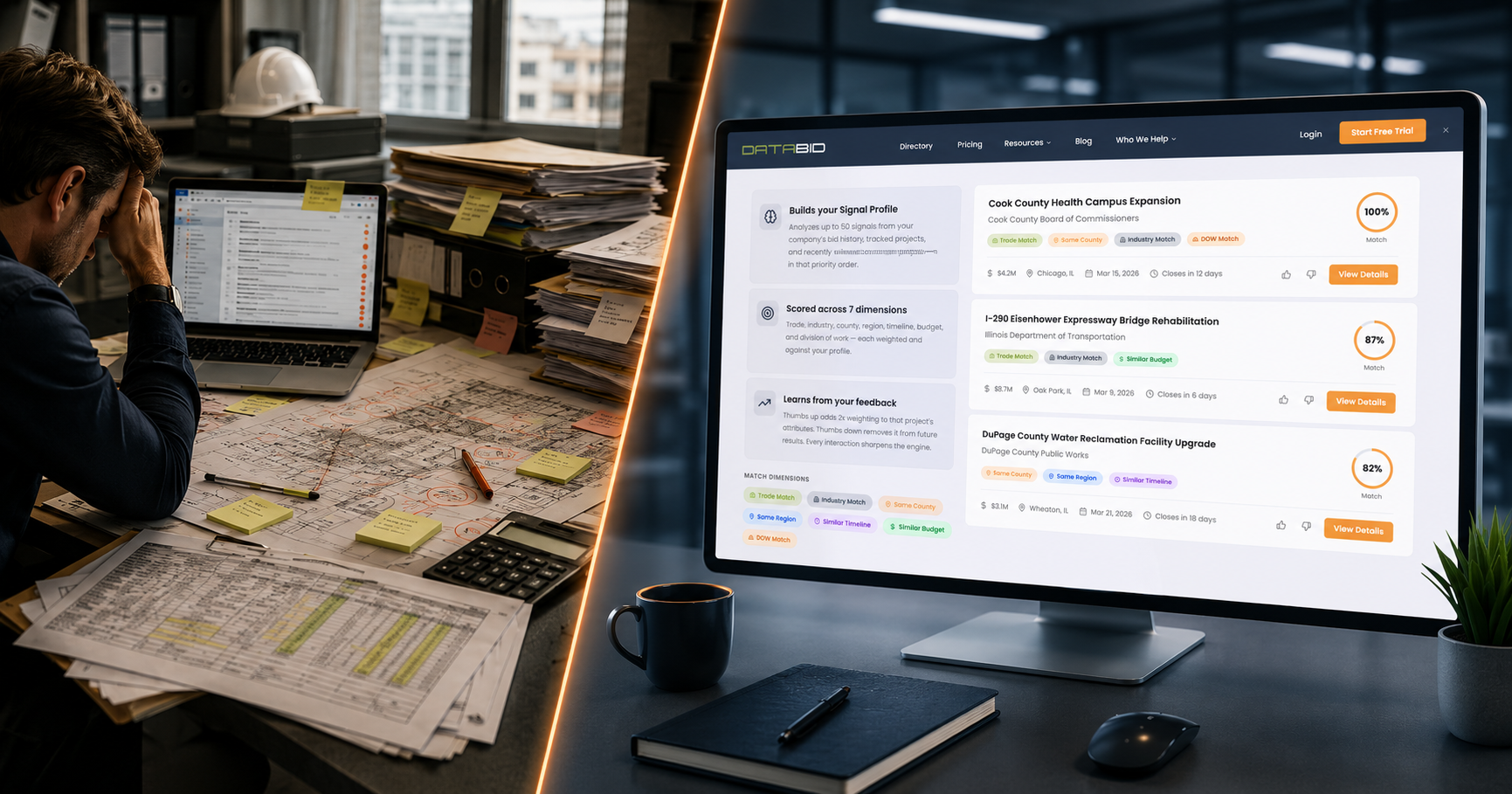
The Old Way vs. The AI Way: How Contractors Find Better Projects Faster
Finding the right construction projects has always taken work. But today, the problem is not just finding opportunities. It is keeping up with all the places those opportunities show up.
Bid notices. Public agency alerts. Invitations from general contractors. Pricing requests from owners. Addenda. Bid date changes. Project updates. Saved search alerts. Daily summaries. Internal forwards.
Some of it matters. A lot of it does not.
That is the problem.
The old way of finding work puts the burden on the contractor to read, sort, search, remember, and decide what deserves attention. The AI way is different. It uses data, patterns, and smarter recommendations to help companies focus on the projects that are more likely to fit the work they actually want.
Construction is still a relationship business. Good judgment still matters. But when the inbox is full and the project list keeps growing, better filtering is no longer a nice-to-have. It is how teams protect their time.
More Leads Are Not Always the Answer
A long list of projects can look impressive, but it does not always help. Most companies don't need more noise. They need better opportunities.
A contractor doesn't want to waste estimating time on projects that are too small, too large, too far away, too early, too late, or outside their normal type of work. A supplier does not want to scroll through endless company names without knowing who is active, what they are working on, or where there may be a real opening.
The real question is not, “How many projects can we find?”
The better question is, “Which projects are actually worth our attention?”
That is where AI starts to become useful. Not as a replacement for experience, but as a way to help sort through the noise faster.
The Inbox Problem Is Real
For many construction companies, the day doesn't start with a clean project list. It starts with an inbox.
A company may be registered with several public agencies, each sending bid notices and updates. General contractors send invitations to bid. Owners send pricing requests. Plan rooms send notifications. Addenda and bid date changes come through. Then project lead services send new project alerts, update alerts, saved search alerts, and daily summaries.
Some of those emails are important. Many are not. The hard part is knowing which is which before a good opportunity is missed or the team spends time chasing the wrong job.
That is one of the biggest problems with the old way. It depends too heavily on people reading, sorting, forwarding, remembering, and manually deciding what deserves attention.
For a busy contractor, the issue is not just finding opportunities. It's filtering the flood.
The Old Way: Too Much Digging and Too Much Guesswork
The traditional way of finding construction work usually involves checking multiple sources, reviewing bid notices, watching project updates, reading email alerts, saving searches, forwarding opportunities, and keeping track of notes across different people and systems.
That process can work. Plenty of companies have built strong pipelines that way.
The problem is that it gets harder as the amount of information grows. There are more projects to track, more emails to sort through, more updates to follow, more companies involved, and more decisions to make about what is worth chasing.
Good opportunities can get missed. Poor-fit projects can waste valuable estimating time. Important updates can get buried in the inbox. Teams can end up relying too much on memory, habits, or whoever happened to notice something first.
For a smaller company, the issue is usually time. There are only so many hours in the day, and nobody wants to spend them opening bid invites that are not a fit. For a larger company, the issue is often focus. The information exists, but it is spread across too many inboxes, departments, people, and tools.
Either way, the result is the same: too much noise and not enough clarity.
The AI Way: Better Signals, Faster Decisions
AI does not magically know which jobs a company should bid. It doesn't replace an estimator, a salesperson, or an owner who knows the market.
What it can do is help identify patterns faster.
When AI is connected to useful construction data, it can help surface projects that look more relevant based on things like trade, location, project type, company activity, past bidding behavior, tracked projects, and other signals.
That matters because construction companies are already overloaded with project information. The value is not just in finding another project. The value is in helping separate the right opportunities from the clutter.
The old way says, “Here is everything. Go sort through it.”
The AI way says, “Based on what we know, these are the opportunities you may want to look at first.”
That does not make the final decision. It makes the first pass smarter.
Why Fit Matters More Than Volume
Estimating time is expensive. Sales time is expensive. Chasing the wrong work is expensive.
Every company has its own version of a good-fit project. For some, it is based on geography. For others, it is trade, project size, owner type, building type, bid stage, relationship history, or who else is involved.
A project that looks perfect for one company may be a complete waste of time for another.
That's why better project matching matters. Before spending time on an opportunity, most construction companies are already asking practical questions:
- Is this the type of work we want?
- Is it in our service area?
- Is the timing right?
- Do we know any of the companies involved?
- Is the project too small, too large, or a good fit?
- Is it worth estimating?
- Is there a real chance to win?
AI can help bring those questions closer to the front of the process. It doesn't remove the need for judgment. It helps teams get to the judgment faster.
What AI-Recommended Projects Really Means
AI-recommended projects should not mean a random list of “popular” jobs. That is not very useful.
The value comes from recommendations that are tied to how a company actually works. The more the system understands what types of projects, trades, companies, locations, and opportunities matter to a user, the more useful the recommendations can become.
For a contractor, that may mean seeing projects that better match the work they typically pursue. For a supplier, it may mean finding active companies and project teams connected to the types of work they serve. For an estimator or business development team, it may mean knowing where to focus first instead of sorting through every possible project.
The best AI does not just create more activity. It helps people decide where to spend their time.
The Old Way vs. The AI Way
| The Old Way | The AI Way |
|---|---|
| Too many emails and alerts to sort through | Better signals that help surface relevant opportunities |
| Manual searches across multiple sources | Smarter recommendations based on project fit |
| Teams rely on memory, folders, and forwarded emails | Users get a clearer starting point |
| Good opportunities can get buried | Better-fit projects can be brought forward faster |
| Estimating time is spent reviewing poor-fit jobs | Teams can focus attention where it is more likely to matter |
| Everyone sees the same long lists | Recommendations can become more personalized over time |
The difference is not that AI does all the work. The difference is that AI can help make the first pass smarter, faster, and more focused.
Human Judgment Still Wins
AI can help sort, recommend, and identify patterns, but construction still requires human judgment.
A good estimator knows when a project is not worth the effort. A good salesperson knows when a relationship changes the opportunity. A good owner knows which jobs fit the direction of the company. A good team knows when the details do not add up.
AI should support those decisions, not replace them.
The companies that get the most value from AI will not be the ones that blindly trust every recommendation. They will be the ones that use AI to save time, reduce noise, and make better decisions faster.
How DataBid Helps
DataBid was built to help construction companies find and track real project activity in their market.
With AI-Recommended Projects, DataBid is making that process smarter. Instead of forcing users to dig through everything from scratch, DataBid can help surface opportunities that better match a company’s project interests, bidding activity, trades, and market focus.
The goal is simple: help users spend less time searching and more time focused on the projects that matter.
That does not mean chasing every lead. It means finding better-fit opportunities faster.
The Bottom Line
The old way of finding construction projects was built on manual searching, scattered information, overloaded inboxes, and a lot of time spent sorting through noise.
The AI way is about using better data and smarter recommendations to help companies focus.
Experience still matters. Relationships still matter. Knowing your market still matters.
But the companies that use AI to find and prioritize better opportunities may have an advantage over the ones still relying only on manual searches and old habits.
Because winning more work does not always start with finding more projects. Sometimes it starts with finding the right projects faster.
Jim Lamelza
Founder & CEO