
Illinois Infrastructure Work Is Coming. Are Heavy Highway Contractors Ready?
Illinois is putting serious money into transportation infrastructure.
Through IDOT’s latest six-year highway and multimodal program, the state has outlined $50.6 billion in planned transportation investment. A major portion of that funding is aimed directly at roads and bridges, including state highways, local roads, bridge work, safety improvements, system modernization, and transportation projects across all 102 counties.
For heavy/highway contractors in Illinois, that is good news.
But more work does not automatically mean more profit.
Road builders, bridge contractors, excavation crews, asphalt companies, concrete contractors, utility firms, traffic control providers, trucking firms, aggregate suppliers, and specialty subcontractors all have a real opportunity ahead.
The contractors who benefit most will not be the ones who blindly bid every job. They will be the ones who prepare earlier, know their numbers, protect their crews, and choose the right projects before the letting date is right on top of them.
The Opportunity Is Real, But So Is the Pressure
Illinois infrastructure work is not just simple resurfacing.
Many projects involve staging, utility coordination, traffic control, lane closures, night work, DBE participation, bonding, public visibility, material risk, and aggressive schedules. Some jobs will be a great fit. Others may look good on bid day but turn into margin problems later.
That is why contractors need to look past the headline number.
A paving contractor may be well-positioned for resurfacing packages. A bridge contractor may see opportunity in deck replacement, structural repair, approach work, and concrete packages. A site contractor may be a good fit for grading, drainage, removals, culverts, and utility coordination. A supplier may see steady demand, but only if they can manage pricing, trucking, and delivery timing.
The real question is not, “Is there work out there?”
The better question is, “Can we build this work profitably?”
Do Not Wait Until the Bid Is Already Hot
Too many contractors operate in reaction mode.
A project hits a letting. The estimator opens the documents. The bid date is close. The team starts calling subs, suppliers, trucking contacts, and bonding people. Everyone is rushing. Questions get missed. Addenda get overlooked. Crews are already committed. Material pricing is moving.
That is a dangerous way to chase public infrastructure work.
Heavy/highway work rewards preparation. If a contractor can see what is coming earlier, they can make better decisions.
They can review upcoming IDOT and local agency work by district, county, route, scope, and timing. They can decide which jobs fit their crews, equipment, bonding capacity, DBE relationships, and production strengths. They can start supplier conversations earlier. They can flag schedule conflicts before they become problems.
That is the difference between chasing work and planning work.
Capacity Matters More Than Ever
A strong backlog is only valuable if it is buildable.
Before bidding, contractors should be honest about crew and equipment capacity. Do you have the right foremen available? Are your operators, laborers, drivers, mechanics, and traffic control crews already stretched? Can you handle the schedule without pulling people from another job? Do you have the trucking, equipment, plant access, and supplier support to perform the work properly?
Winning a job you cannot staff is not a win.
It can lead to production issues, overtime, safety problems, liquidated damages, rework, and burned-out crews. Public infrastructure work can be profitable, but only when the job fits the company’s real capacity.
Bonding capacity also needs to be managed before the bid date. If a contractor ties up too much capacity on the wrong jobs, it may limit their ability to pursue better-fit work later in the season.
The question should not be, “Can we bid this?”
The question should be, “Should we bid this?”
Material Pricing and Lead Times Can Change the Job
Road and bridge work can be heavily exposed to material risk.
Asphalt, concrete, aggregate, pipe, drainage structures, rebar, structural steel, electrical components, guardrail, signage, signals, lighting, and fuel can all affect the final margin. Even when pricing is stable, timing matters.
Contractors should pay close attention to escalation exposure, fuel assumptions, supplier quote windows, pipe and drainage lead times, structural steel timing, traffic signal components, trucking availability, and addenda that change quantities or scope.
A job that looks profitable during the first review can look very different once the material and schedule risks are fully understood.
That is another reason early planning matters.
The more time a contractor has to review upcoming work, talk to suppliers, and compare project fit, the better chance they have of protecting the margin.
Local Agency Work Deserves Serious Attention
When contractors hear public infrastructure, they often think first about major IDOT lettings. But local agency work can be just as important.
Counties, municipalities, townships, park districts, school districts, transit agencies, and other public owners all create opportunities for heavy/highway and civil contractors.
That can include road resurfacing, sidewalk and curb work, storm sewer improvements, culvert replacements, bridge repairs, parking lot reconstruction, intersection improvements, traffic signal upgrades, utility coordination, drainage improvements, and road widening.
For some contractors, local work may be a better fit than large state highway packages. The job size may align better with their crews. The geography may be tighter. The scope may be more familiar. The relationships may be stronger.
The challenge is that local public work can be scattered across municipal websites, county procurement pages, bidding portals, meeting notes, and capital improvement plans.
Contractors that rely only on what lands in their inbox can miss good opportunities.
Subs and Suppliers Should Watch the Pipeline Too
Public infrastructure work creates opportunity beyond the prime contractor.
Traffic control companies, striping contractors, guardrail firms, signal contractors, erosion control providers, concrete subs, drainage suppliers, aggregate suppliers, asphalt producers, trucking companies, equipment rental firms, and testing companies should all be watching what is coming.
Waiting until bid week is often too late.
By then, many primes already have preferred subs and suppliers in mind. The companies that show up earlier with pricing support, availability, local knowledge, and useful information have a better chance of becoming part of the bid strategy.
For suppliers especially, upcoming infrastructure work is not just a sales opportunity. It is an inventory, logistics, and relationship-planning issue.
Contractors Need a Real Bid Calendar
A list of projects is not enough.
Heavy/highway contractors need a practical way to organize opportunities by timing, geography, scope, owner, route, letting date, plan availability, addenda, competitors, subs, and internal interest.
A good bid calendar helps answer the questions that matter:
What is coming up in the next 30, 60, and 90 days?
Which jobs fit our crews and equipment?
Which jobs need early supplier input?
Which jobs require bonding conversations?
Which opportunities should we track but not bid?
Which primes are likely to chase this work?
Which local agencies have recurring programs?
Which jobs are too far, too small, too risky, or too crowded?
The goal is not to bid everything. The goal is to avoid surprises and focus on the work that fits.
Where DataBid Fits Into the Planning Process
For Illinois heavy/highway contractors, the hard part is not knowing that infrastructure work exists. The hard part is keeping track of the right opportunities, the right updates, the right letting dates, and the right bidding activity without wasting hours jumping between sources.
That is where DataBid can help.
DataBid tracks Illinois construction opportunities, including road, bridge, utility, sitework, paving, municipal, and public infrastructure projects. Contractors can follow projects that match their market, receive alerts when important updates are posted, and stay ahead of changes instead of finding out too late.
For IDOT and public-sector work, that visibility matters.
A contractor may want to know when a project is updated, who is bidding, which companies have shown interest, or how certain contractors have bid on previous lettings. That kind of information can help a team decide whether a project is worth chasing, where they may have an edge, and how competitive the opportunity may become.
It is not about bidding more work.
It is about making better decisions before bid day.
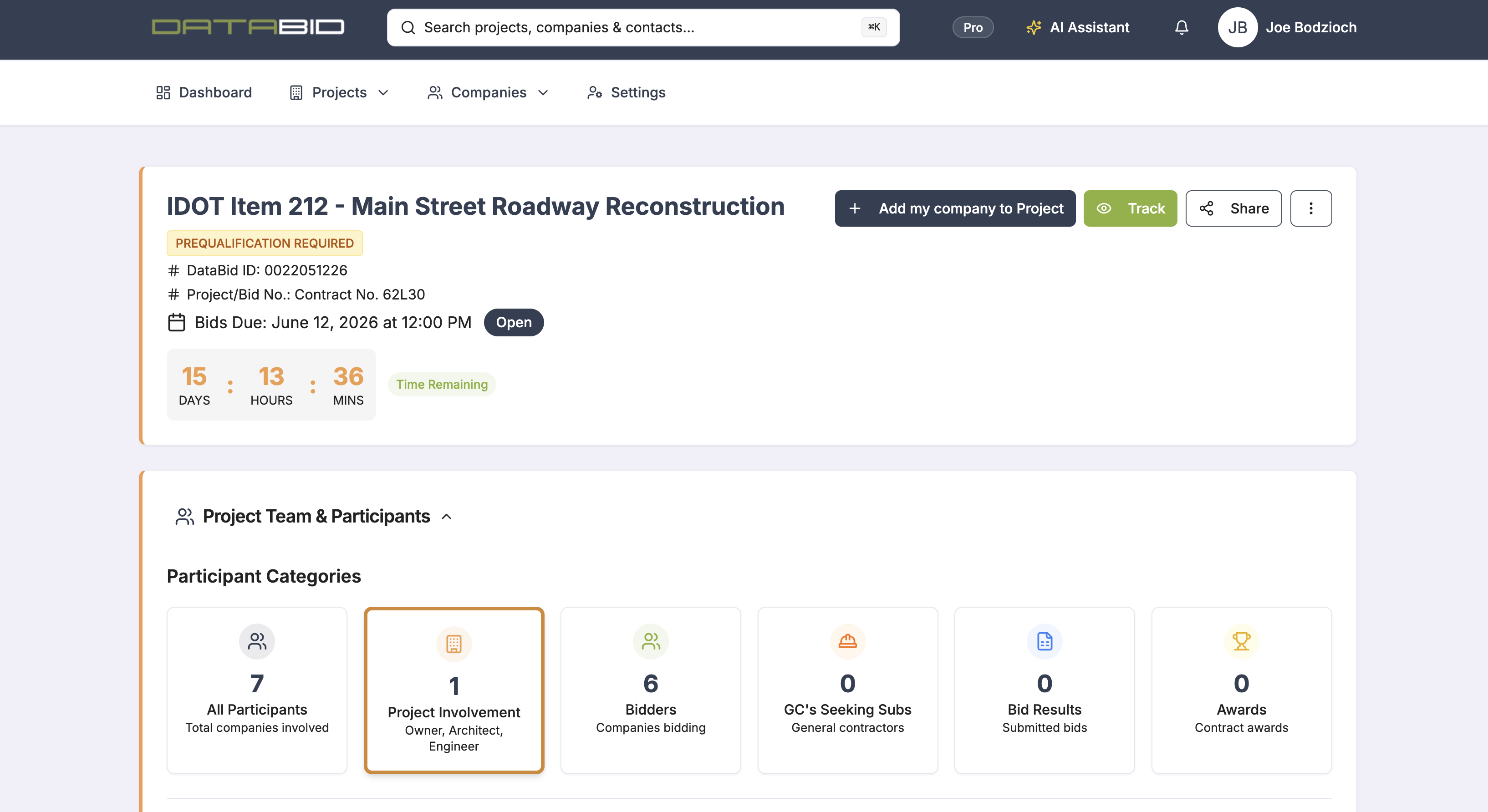 Example of an Illinois public infrastructure project tracked inside DataBid, including project details, bidding activity, updates, and related contractor information.
The Bottom Line
Illinois infrastructure spending should create real opportunities for heavy/highway contractors.
But the companies that benefit most will not be the ones that chase every road, bridge, drainage, resurfacing, and utility job that appears. They will be the contractors that understand their capacity, manage risk, protect their estimating time, and focus on work that fits their strengths.
Roads need work. Bridges need attention. Local agencies have needs. Safety improvements, drainage upgrades, utility coordination, and resurfacing programs will continue to move forward.
For contractors, the question is not whether work is out there.
The question is whether they are prepared to find it early, qualify it properly, and build it profitably.
Jim Lamelza
Founder & CEO