
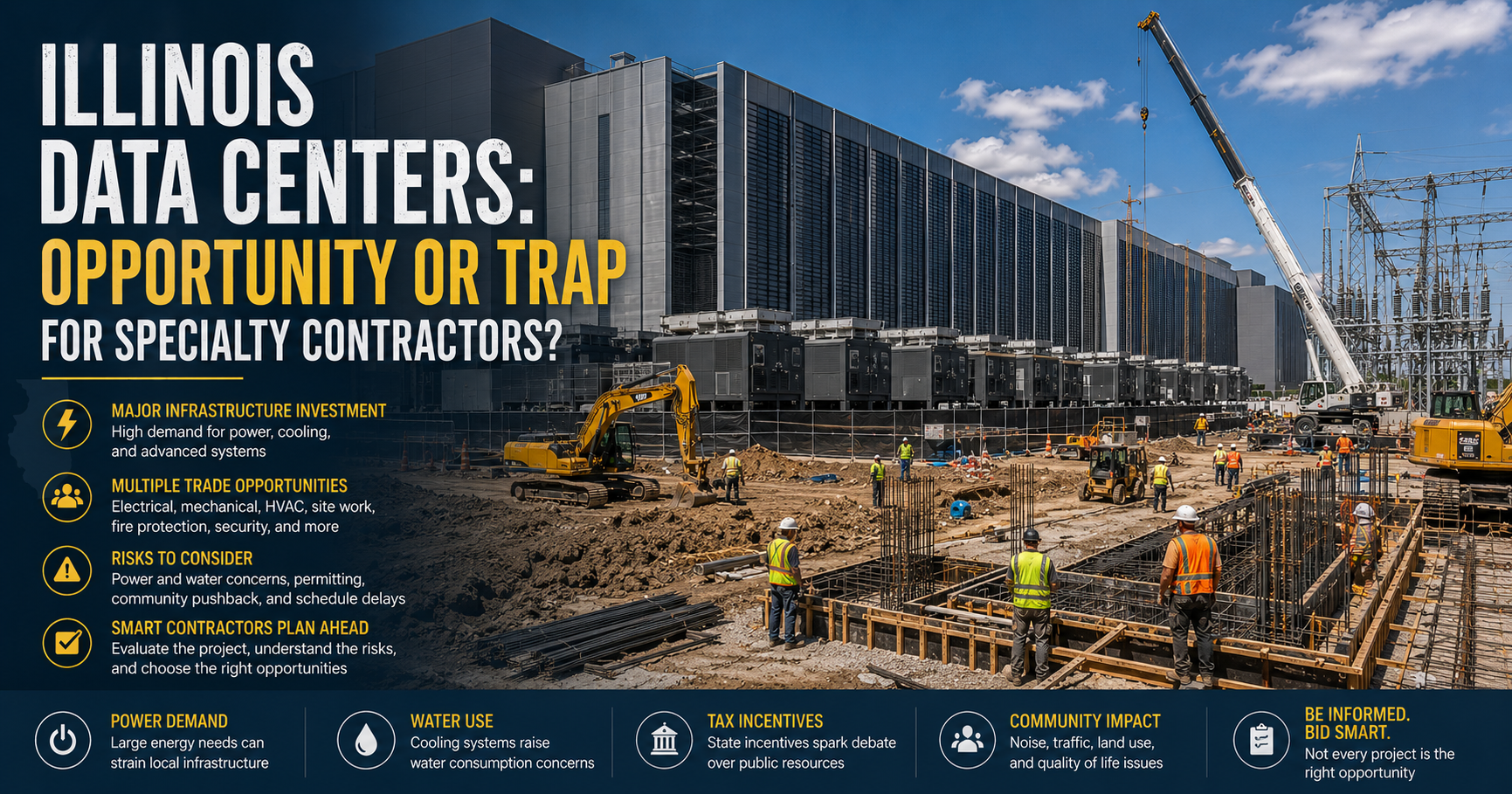
Illinois Data Centers: Opportunity or Trap for Specialty Contractors?
Data centers are becoming one of the biggest construction stories in Illinois.
Driven by cloud computing, artificial intelligence, and demand for more digital infrastructure, data center projects are showing up across the state. For specialty contractors, that can sound like a major opportunity.
And for some, it may be.
Electrical contractors, mechanical contractors, HVAC firms, controls specialists, fire protection companies, security contractors, sitework firms, concrete contractors, utility contractors, steel contractors, trucking companies, and material suppliers may all see work connected to this market.
But data centers are not a simple good-news story.
These projects are also drawing pushback from residents, environmental groups, lawmakers, and utility customers. Concerns include power demand, water use, noise, land use, tax incentives, local infrastructure, and whether these facilities create enough long-term jobs to justify the impact.
For contractors, the smart position is not “for” or “against” data centers.
The smart position is to understand the opportunity, understand the risk, and decide which projects are actually worth chasing.
Why Data Centers Matter to Illinois Contractors
Data centers are not just buildings filled with servers. They are major infrastructure projects.
They need land, power, fiber, roads, utility connections, drainage, concrete, steel, cooling systems, backup power, fire protection, security systems, controls, and highly coordinated construction teams.
That creates work across many trades.
Electrical contractors may see opportunities tied to switchgear, generators, UPS systems, transformers, grounding, distribution, lighting, controls, and low-voltage systems.
Mechanical and HVAC contractors may be needed for cooling, ventilation, piping, equipment installation, redundancy, and energy performance.
Sitework and utility contractors may be involved in grading, stormwater, duct banks, underground utilities, road improvements, and site access.
Concrete and structural contractors may see work tied to slabs, foundations, equipment pads, structural systems, and phased campus buildouts.
Suppliers may see demand for materials and equipment, but only if they can manage pricing, lead times, trucking, and delivery schedules.
There is opportunity here, but it is not the right opportunity for every company.
The Boom Is Real, But So Is the Pushback
Illinois has been actively competing for data center investment. The state offers a data center investment program that provides tax exemptions for qualifying projects and a 20% construction-wage credit for qualifying projects located in underserved areas.
That helps explain why data center development has become such a major topic in Illinois.
But public concern is growing too.
Communities and lawmakers are asking harder questions about electricity demand, water use, local infrastructure, environmental impact, utility costs, transparency, and tax incentives. Some critics argue these projects can use a large amount of public resources without creating the same level of permanent employment as other types of development.
That matters to contractors because controversy can affect construction.
A proposed data center may face zoning fights, permitting delays, community opposition, utility questions, or changes to the development schedule. A project that looks active today may slow down, shift phases, or sit in limbo while local issues are worked out.
Contractors do not need to take a political position to understand the practical reality.
Not every announced data center is a guaranteed job.
Before spending serious estimating time, contractors should ask:
Is the project fully approved?
Is power secured?
Are water and utility needs resolved?
Is there local opposition?
Is the schedule realistic?
Are long-lead items already ordered?
Who controls procurement?
What risks are being pushed down to subcontractors?
Those questions can protect a company from chasing a project that is not ready or not worth the risk.
The Upside: Big Projects With Serious Trade Demand
The upside is clear.
Data center projects can be large, well-funded, and trade-heavy. They often require qualified contractors and suppliers across electrical, mechanical, HVAC, controls, fire protection, security, concrete, sitework, utility, trucking, and materials.
They may also be built in phases. That can create repeat opportunities for companies that perform well.
A subcontractor that proves it can handle the pace, documentation, safety requirements, and coordination may be considered for future phases. A supplier that can deliver reliably under pressure may become more valuable to the project team. A contractor that understands the technical requirements may stand out from companies treating the job like standard commercial work.
Data centers can also create work outside the building itself.
Road improvements, utility extensions, stormwater work, duct banks, fencing, site lighting, security infrastructure, and local upgrades may all come into play depending on the site.
For the right contractors, this market can be meaningful.
But only if the job is priced, staffed, and managed properly.
The Trap: Big Contract Value Does Not Mean Good Margin
This is where contractors need to be careful.
Data centers can be fast-moving, complex, and unforgiving. Owners and developers often want capacity online quickly. That schedule pressure can roll downhill to every contractor on the job.
The biggest risks include:
Labor strain
Long-lead electrical gear
Compressed schedules
Pricing volatility
Scope gaps
Heavy coordination requirements
Strict documentation
Design changes
Utility and power delays
Safety and quality expectations
Electrical risk is especially important. Data centers depend on large amounts of power. Transformers, switchgear, generators, panels, controls, and related components can affect the schedule long before crews are ready to install.
Mechanical risk can be just as serious. Cooling is not a secondary feature in a data center. It is mission critical. Mistakes in sequencing, coordination, installation, or commissioning can cause major problems.
A big project can look attractive on the surface. But if the schedule is unrealistic, materials are uncertain, crews are stretched, or the contract pushes too much risk onto subcontractors, the job can become a margin trap.
The question is not just, “Can we bid this?”
The better question is, “Can we make money on this without hurting the rest of our business?”
How Specialty Contractors Should Evaluate Data Center Work
Data center work deserves a serious bid/no-bid review.
Before pricing the project, contractors should look at fit, capacity, risk, and payment terms.
Ask:
Do we have experience with this type of work?
Can we staff the job without robbing other projects?
Do we understand the schedule requirements?
Are the specs complete enough to price properly?
Are long-lead materials clearly addressed?
Are escalation risks covered?
Is the GC or owner experienced with data centers?
Are change order procedures clear?
Are payment terms reasonable?
Do we have the right suppliers and subs lined up?
Contractors should also watch the local approval process. If the project is facing community pushback, utility concerns, or zoning delays, that can affect when the work actually moves.
This is not about being negative. It is about being realistic.
A data center can be a great opportunity for one contractor and a bad fit for another.
Where DataBid Fits Into the Planning Process
For Illinois contractors, the challenge is not just knowing that data center work exists. The challenge is tracking which projects are real, where they are located, who is involved, what stage they are in, and when opportunities may open up.
That is where DataBid can help.
DataBid tracks Illinois construction opportunities, including data centers, sitework, utility work, commercial projects, public infrastructure, and related bid activity. Contractors can follow projects, monitor updates, receive alerts when important changes are posted, and review who is bidding when that information is available.
That visibility can help contractors plan earlier instead of scrambling when a project is already moving.
It is not about chasing every data center project.
It is about knowing which ones are worth watching, which ones fit your company, and which ones may carry more risk than reward.
The Bottom Line
The data center boom in Illinois is real, but it is also controversial.
For some specialty contractors and suppliers, these projects may create strong opportunities across electrical, mechanical, HVAC, controls, fire protection, security, concrete, sitework, utility, trucking, and materials.
For others, the risks may outweigh the upside.
These projects can bring pressure around labor, long-lead equipment, power availability, water use, community opposition, zoning, schedules, pricing, and coordination. Contractors that treat every data center opportunity as a great opportunity may get burned.
The winners will be the companies that stay neutral, study the facts, qualify the work carefully, and understand both the construction opportunity and the project risk.
The question is not whether data centers are good or bad.
The question for contractors is whether a specific project is real, buildable, properly priced, and worth pursuing.
Jim Lamelza
Founder & CEO