
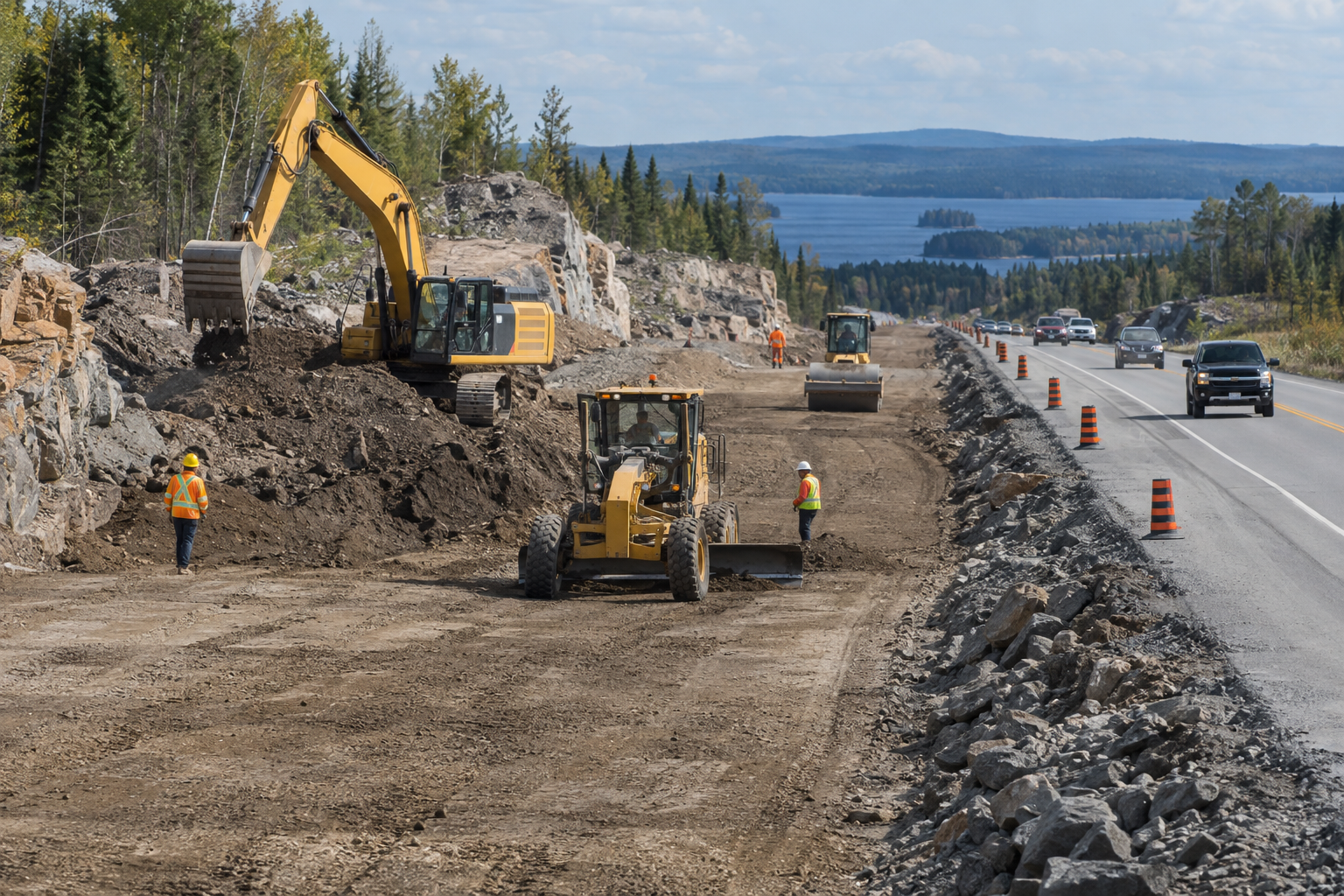
Highway 69 Widening South of Sudbury Targets 2027 Start
The Government of Ontario plans to advance four-laning of the final 68 kilometres of Highway 69 south of Greater Sudbury, Ontario, with four of six sections targeted to be under heavy construction by the end of 2027. The project remains in the pre-construction stage, with a rail relocation agreement secured to accommodate a future interchange at Highway 522.
In its August 2026 coverage, Northern Ontario Business reports that the province has reached an agreement with the Canadian National Railway Company to relocate part of its existing rail line. The six highway sections are to open to contractors through separate requests for proposals.
For civil contractors and suppliers, the procurement approach creates separate sections to assess rather than a single contract covering the entire remaining corridor. Rail relocation, interchange construction and ongoing negotiations affecting portions of the route are key considerations for pursuit planning.
Key Project Facts
- Project type: Highway widening from two lanes to four lanes, with rail relocation supporting a future interchange.
- Location: Highway 69 south of Greater Sudbury, Ontario; rail relocation within the Township of Mowat and the Municipality of Killarney.
- Size: Final 68 kilometres of highway widening, divided into six sections.
- Owner: Government of Ontario.
- Stage: Pre-construction, with a rail relocation agreement reached and separate requests for proposals planned.
- Timeline: Four sections targeted to be under heavy construction by the end of 2027.
Six Highway Sections to Proceed Through Separate RFPs
The province has divided the remaining 68-kilometre, two-lane portion of Highway 69 into six sections. Northern Ontario Business reports that each section will be offered to contractors through a separate request for proposals.
At the August 25, 2026 announcement, Transportation Minister Prabmeet Singh Sarkaria said dividing the corridor into smaller projects was intended to increase competition and accelerate delivery. The stated construction target applies to four of the six sections by the end of 2027.
For estimating teams, the section-by-section approach makes individual RFP scope and sequencing important. Contractors can assess each opportunity against their civil construction capacity, while subcontractors and suppliers can evaluate the requirements of each section as procurement advances.
Three sections correspond to the three First Nations communities through which the project is planned to pass. At the August announcement, the province said negotiations with all three First Nations were ongoing and being handled independently.
Rail Relocation Supports the Highway 522 Interchange
The agreement with the Canadian National Railway Company covers relocation of a portion of the existing rail line within the Township of Mowat and the Municipality of Killarney. The relocation is intended to accommodate the future Highway 69 interchange at Highway 522.
The interchange location is near the northern end of the remaining 68-kilometre stretch. This makes the rail agreement directly relevant to advancing the highway layout at that location, rather than a separate transportation initiative.
For contractors considering this work, the relationship between rail relocation and interchange delivery is a central construction consideration. Potential planning requirements could include coordination of rail and highway work areas, construction access and sequencing where the two scopes meet.
Construction Planning Across an Existing Two-Lane Corridor
The Highway 69 scope involves expanding an existing two-lane route to four lanes. Contractors evaluating future RFPs should distinguish the corridor-wide widening objective from the specific work assigned to each section.
Potential execution considerations could include:
- Traffic staging and work-zone protection alongside the existing highway.
- Earthworks, grading and pavement construction sequencing within each section.
- Coordination between highway construction and the rail relocation supporting Highway 522.
- Material delivery and equipment access across separate construction areas.
- Interfaces between adjoining highway sections.
These considerations follow from the widening scope and the six-section delivery approach. The 2027 milestone is a target for heavy construction on four sections, not a corridor opening date.
Construction Trades Involved
With the remaining Highway 69 widening in pre-construction, the highway, interchange and rail relocation scope could involve a range of civil construction specialists.
Potential trades include:
- Construction surveying and layout
- Site clearing and grubbing
- Erosion and sediment control
- Excavation and earthmoving
- Rock excavation
- Grading and embankment construction
- Aggregate supply and placement
- Road-base preparation and compaction
- Drainage and culvert installation
- Concrete formwork and placement
- Asphalt paving
- Guide rail and roadside barrier installation
- Traffic control and temporary signage
- Permanent highway signage
- Pavement marking
- Rail track relocation and installation
- Rail ballast placement
- Topsoil placement and revegetation
Frequently Asked Questions
How much of Highway 69 remains to be widened?
The province's plan covers the final 68 kilometres of two-lane Highway 69, divided into six sections for four-laning.
When is construction expected to start?
The province's August 2026 announcement targeted four of the six sections to be under heavy construction by the end of 2027.
What does the rail relocation agreement enable?
The agreement with the Canadian National Railway Company supports relocation of part of the existing rail line within the Township of Mowat and the Municipality of Killarney to accommodate a future interchange at Highway 522.
For contractors and suppliers, the next pursuit focus is the separate RFP process and the scope attached to each highway section. The combination of road widening, interchange work and rail relocation makes section-specific sequencing particularly important when assessing capacity and pricing.
Contractors, subcontractors and suppliers can follow projects like this one on DataBid. Start a free trial.
Judy Lamelza
Editor-in-Chief