
Best Platforms for Commercial Bid Tracking in 2026
There is no single best platform for commercial bid tracking in 2026 - there is a best platform for the way your company actually wins work.
Autodesk BuildingConnected is the strongest invite-to-bid network for general contractors. ConstructConnect and Dodge have the widest national construction project databases. DataBid is built for subcontractors and suppliers who need early-stage projects, real bid results, and deep regional coverage. PlanHub and Procore Bid Board are useful value picks for smaller subcontractors already managing bids in email or spreadsheets.
Most “best bid tracking software” lists are written by people who have never sat in a bid room at 1:45 PM with a scope gap, a missing addendum, and three estimators asking who else is bidding. This list is written from the reality of commercial construction: finding the right projects early, knowing which general contractors are involved, tracking bid dates, seeing plan holders, and using bid results to make better decisions the next time.
Below is a practical breakdown of the best commercial bid tracking platforms in 2026, what each one does well, where each one falls short, and how contractors, subcontractors, and suppliers should choose.
How We Evaluated the Best Commercial Bid Tracking Platforms
Commercial bid tracking is not just about having a long list of projects. More projects does not automatically mean better opportunities. A strong construction lead generation platform should help your team answer six questions quickly:
- Can we find projects early enough to influence the opportunity?
- Can we see the owner, architect, engineer, general contractors, and plan holders?
- Can we track bid dates, prebid meetings, addenda, and scope changes?
- Can we see public and private commercial projects?
- Can we review bid results after the job closes?
- Can we search by region, trade, project type, company, and keyword without wasting time?
Those are the criteria used in this comparison.
Quick Comparison: Best Commercial Bid Tracking Platforms in 2026
DataBid
Best for: Commercial General Contractors, Subcontractors and Suppliers
Strengths: Early-stage projects, bid results, plan holders, private project reporting, regional depth
Limitations: Regional coverage, not national
Best fit: Subs, suppliers, and regional GCs who want deeper local intelligence
Autodesk BuildingConnected
Best for: General contractors managing invitations to bid
Strengths: Large subcontractor network, bid management, prequalification tools
Limitations: Not an independent construction lead database for subs
Best fit: GCs sending ITBs and managing bid day
ConstructConnect
Best for: Larger contractors needing broad North American coverage
Strengths: Large national database, project search, takeoff integrations
Limitations: Regional depth can vary, pricing is quote-based
Best fit: Multi-state GCs and large subcontractors
Dodge Construction Network
Best for: Early-stage market intelligence and manufacturers
Strengths: Planning-stage projects, market data, forecasting
Limitations: Expensive, not always ideal for bid-day subcontractor workflows
Best fit: Manufacturers, reps, and national business development teams
PlanHub
Best for: Smaller subcontractors looking for accessible bid opportunities
Strengths: Easy to use, published pricing, plan access
Limitations: More of a bid marketplace than a full project intelligence platform
Best fit: Small to mid-sized subcontractors
Procore Bid Board
Best for: Subcontractors already using Procore or receiving many ITBs
Strengths: Free bid organization, deadline tracking, ITB management
Limitations: Does not help much with finding new work
Best fit: Subs who need to organize bids they already receive
Biddingo, MERX, Bids&Tenders, Bonfire, and public tender portals
Best for: Canadian public-sector bidding
Strengths: Official public tender documents and addenda
Limitations: Fragmented, limited private work, limited company intelligence
Best fit: Contractors bidding specific public agencies
Free public portals
Best for: Contractors focused on one agency or one narrow public market
Strengths: Free and official
Limitations: Time-consuming, fragmented, no private project coverage
Best fit: Contractors with a very narrow public-sector focus
1. DataBid: Best for Commercial General Contractors, Subcontractors and Suppliers Who Need Early-Stage Projects and Bid Results
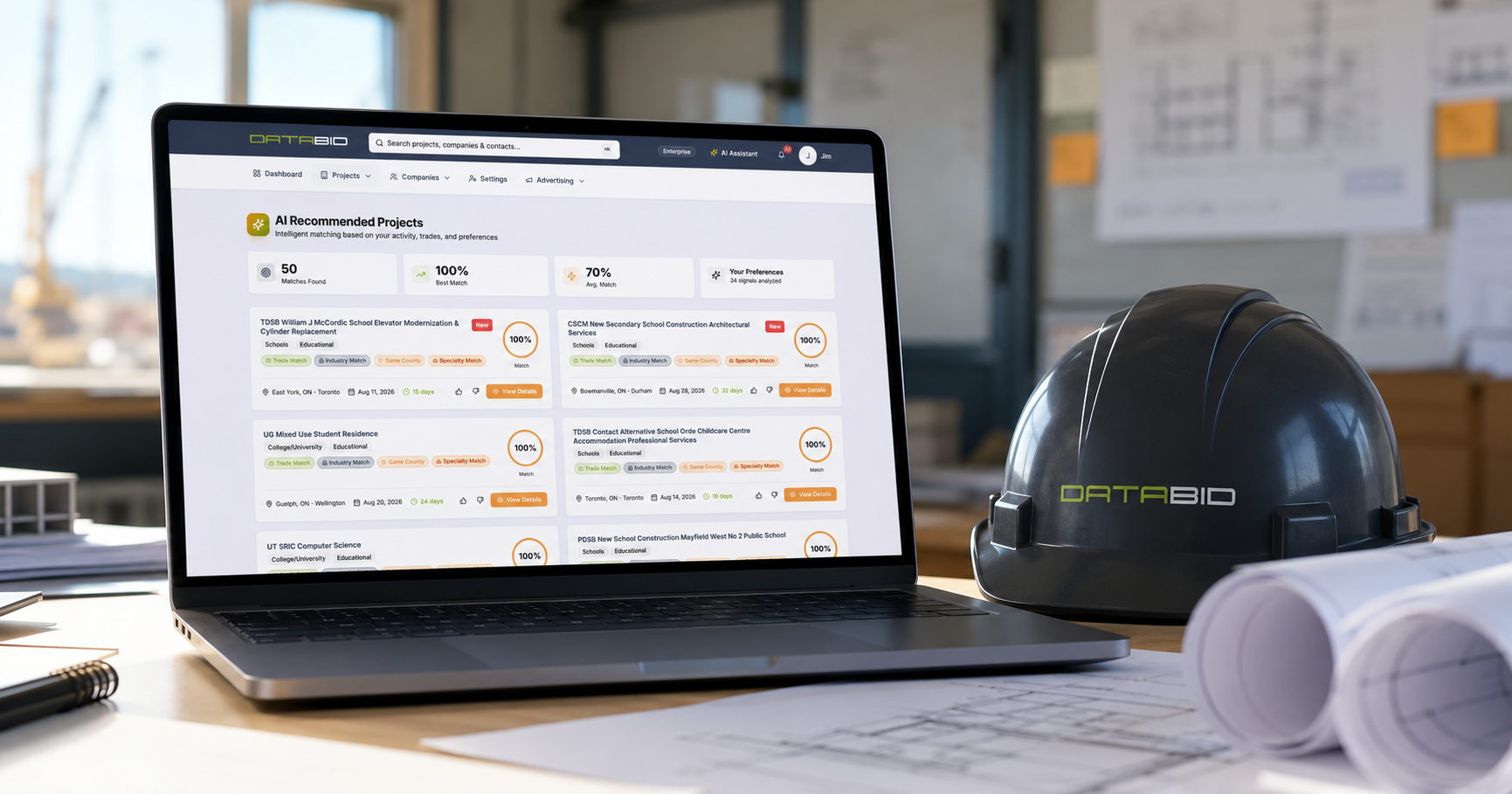
DataBid is a construction project information service covering built for commercial contractors, subcontractors, and suppliers who need to find real opportunities before bid day - not just receive invitations after everyone else already knows about the job.
DataBid tracks public and private commercial construction projects, including projects in planning, design, pre-bid, bidding, and post-bid stages. The platform includes project details such as owner, architect, engineer, general contractors, plan holders, invited bidders, prebid meetings, bonding requirements, scope notes, documents, bid dates, and bid results.
The strongest part of DataBid is regional depth. In commercial construction, local coverage matters. A national database can look impressive, but if it misses school board work, municipal projects, private retail, restaurants, industrial buildings, or local general contractors in your actual territory, it does not help your estimating team.
DataBid is especially valuable for subcontractors and suppliers because it focuses on the full opportunity cycle. You can find projects early, track who is involved, follow updates, see who is bidding, and review bid results after the closing date. That creates a feedback loop. You are not just chasing leads, you are learning the market.
For example, a subcontractor can search for upcoming projects in their region, identify which GCs are bidding, contact the right estimators, track the bid date, and then later review the results to understand pricing, competitors, and future opportunities.
DataBid is not a bidding platform or middleman. Contractors do not submit bids through DataBid. It is an information service that helps companies know what is happening, who is involved, and where to focus.
Best for: Commercial subcontractors, suppliers, and regional general contractors.
Strengths:
- Strong early-stage project visibility
- Public and private project coverage
- Bid results with bidders and amounts
- Company directory with contacts and project history
- Saved searches and alerts
- Deep regional focus
- Published regional pricing
Limitations:
- Not national
- Not a bid submission platform
2. Autodesk BuildingConnected: Best Invite-to-Bid Network for General Contractors
Autodesk BuildingConnected is one of the most widely used bid management platforms in North America. It is especially strong for general contractors who need to send invitations to bid, manage subcontractor responses, organize bid packages, and track bid coverage.
For GCs, BuildingConnected is a powerful tool. It gives preconstruction teams access to a large subcontractor network and helps manage the bid process from invitation through submission. Its related prequalification tool, TradeTapp, is also widely used by general contractors evaluating subcontractor risk.
For subcontractors, BuildingConnected is important because many GCs use it to send ITBs. Having a profile and monitoring invitations is often necessary.
But BuildingConnected is not the same thing as a construction lead database. A subcontractor generally sees the projects they are invited to. If a GC you do not already know is bidding a school, hospital, warehouse, or municipal job in your region, BuildingConnected may not alert you unless you are already included in that GC’s bid list.
That is the key limitation. BuildingConnected is excellent for managing bid invitations, but it is not built to independently show every project in your territory, every plan holder, every public opportunity, every private lead, or every bid result.
Best for: General contractors managing invitations to bid.
Strengths:
- Large GC and subcontractor network
- Strong ITB management
- Bid package organization
- Prequalification tools
- Useful for bid day workflow
Limitations:
- Subcontractors mostly see what they are invited to
- Limited independent project discovery
- No broad public bid results database
- Pricing is generally quote-based
3. ConstructConnect: Best National Construction Project Database for Large Contractors
ConstructConnect is one of the largest construction information platforms in North America. It includes project leads, documents, company information, takeoff tools, and bid management capabilities. Over time, it has brought together several well-known construction data brands, including iSqFt, BidClerk, and SmartBid.
The biggest advantage of ConstructConnect is breadth. If your company works across many states or provinces, it can provide a large searchable database of projects from planning through bidding. For larger general contractors and subcontractors, that national reach can be useful.
ConstructConnect can be a strong choice for companies that need one broad platform across multiple regions. It also offers integrations and tools that support estimating and takeoff workflows.
The challenge is that broad coverage does not always mean deep coverage. In construction lead generation, a huge national database may still miss smaller municipal projects, private commercial work, or local opportunities in a specific county or region. For many subcontractors, the issue is not whether there are enough total projects in the system - it is whether the system has the right projects in their exact service area.
Pricing can also be a consideration. ConstructConnect pricing is typically quote-based, and larger subscriptions may involve annual or multi-year commitments.
Best for: Multi-state general contractors and larger subcontractors.
Strengths:
- Broad North American project coverage
- Large project database
- Takeoff and estimating tools
- Useful for national companies
- Planning and bidding-stage project search
Limitations:
- Regional depth varies
- Private/local project details may be inconsistent
- Pricing is quote-based
- Can be more platform than smaller teams need
4. Dodge Construction Network: Best for Early-Stage Market Intelligence
Dodge Construction Network is one of the oldest and most recognized names in construction data. It is especially known for early-stage project intelligence, market forecasting, and construction analytics.
Dodge can be very useful for manufacturers, building product companies, sales teams, and business development groups that want to identify projects at the planning or design stage. If your company sells products that need to be specified early - such as roofing systems, HVAC equipment, flooring, glazing, elevators, or specialty materials - Dodge can help identify opportunities before they reach bid day.
The strength of Dodge is early visibility and market intelligence. It can help companies understand where construction demand is heading, what sectors are active, and which projects may be coming in the future.
The limitation is that early-stage data can be soft. Not every planning-stage project becomes a real bid. Some projects are delayed, redesigned, cancelled, or changed significantly before they reach the market. For subcontractors who need actionable bid dates, plan holders, bidding GCs, addenda, and bid results, Dodge may not always match the day-to-day estimating workflow.
Dodge is often better for market strategy and specification sales than for a subcontractor trying to decide what to bid this week.
Best for: Manufacturers, suppliers, reps, and national market intelligence teams.
Strengths:
- Strong early-stage project intelligence
- Market forecasting
- Planning and design-stage visibility
- Useful for specification sales
- Strong brand recognition
Limitations:
- Premium pricing
- Not always ideal for bid-day subcontractor workflows
- Early-stage projects may not become active bids
- Bid results and local bidder intelligence may be limited
5. PlanHub: Best Value Option for Smaller Subcontractors
PlanHub is a construction bid marketplace that helps general contractors post projects and subcontractors find bid opportunities. It is often used by smaller subcontractors because it is easier to access than some larger enterprise platforms and has more transparent pricing.
For subcontractors moving away from email, Dropbox links, and spreadsheet tracking, PlanHub can be a helpful step up. It gives users access to plans, project information, and invitations from participating GCs.
PlanHub’s biggest advantage is accessibility. Smaller contractors can get started without the same complexity or cost that may come with larger platforms.
The limitation is that PlanHub is still largely a marketplace. Coverage depends on which GCs are posting projects in a given area. It does not function like a full regional construction intelligence service with reporter-sourced private work, early planning-stage tracking, detailed company history, and bid results.
For some trades and markets, PlanHub can be very useful. For others, coverage may be thin.
Best for: Small to mid-sized subcontractors looking for accessible bid opportunities.
Strengths:
- Easier to start using
- Published pricing
- Plan access
- Good for smaller subcontractors
- Useful in active markets
Limitations:
- Coverage varies by region
- No strong independent early-stage feed
- Limited bid results
- Less private project intelligence
6. Procore Bid Board: Best Free Tool for Organizing Bids You Already Have
Procore Bid Board is a free tool for subcontractors that helps organize invitations to bid, deadlines, files, and bid activity. It is especially useful for subcontractors already working with GCs who use Procore.
The major benefit is organization. Many subcontractors lose time because bid invitations are scattered across email inboxes, file links, spreadsheets, and calendars. Procore Bid Board helps centralize that information and makes it easier to manage deadlines.
It is also free, which makes it an easy recommendation for subcontractors who need basic bid organization.
But Procore Bid Board is not a construction lead generation platform. It does not independently find new projects for you. It does not show a broad database of public and private work in your region. It does not provide bid results or detailed market intelligence.
It is a good tool for managing bids you already know about. It is not a complete solution for finding more work.
Best for: Subcontractors who need to organize incoming ITBs.
Strengths:
- Free
- Simple bid organization
- Good for deadline tracking
- Helps manage incoming invitations
- Useful for Procore-connected workflows
Limitations:
- Not a project discovery platform
- No independent lead database
- No early-stage project tracking
- No bid results
7. Biddingo, MERX, Bids&Tenders, Bonfire, and Public Tender Portals: Best for Canadian Public Bidding
In Canada, many public-sector opportunities are posted through portals such as Biddingo, MERX, Bids&Tenders, Bonfire, and Alberta Purchasing Connection. These platforms are essential for contractors bidding public work because they often contain the official documents, addenda, plan files, and submission instructions.
For public-sector bidding, these portals matter. If a municipality, school board, university, healthcare organization, or government agency posts a tender there, contractors need to monitor it.
The problem is fragmentation. A contractor bidding across Ontario or Alberta may need to check many different portals, agency websites, municipal pages, and purchasing systems. Each portal may have different search tools, notification rules, document access, and terminology.
These systems also do not solve private project discovery. They generally do not show restaurants, retail buildouts, private industrial work, condo projects, or owner-direct commercial jobs unless those projects are publicly tendered.
They are official sources, but they are not complete market intelligence platforms.
Best for: Contractors focused on Canadian public-sector work.
Strengths:
- Official public tender postings
- Real documents and addenda
- Important for compliance
- Strong for specific agencies
Limitations:
- Fragmented across many portals
- Limited private work
- Limited cross-portal search
- Limited company intelligence
- Limited bid history
8. Free Public Portals: Best for Contractors Focused on One Agency
Free public portals include state DOT websites, county purchasing pages, school board bid pages, municipal procurement sites, SAM.gov, and similar agency-specific websites.
These are useful because they are official and free. If your company only bids one agency or one narrow type of public work, free portals may be enough.
For example, a contractor focused only on one school district, one transportation agency, or one municipality may be able to monitor that source manually.
The problem is time and coverage. Once your team is checking more than a few websites each week, the “free” system becomes expensive. Someone has to remember to check every site, download documents, track addenda, record bid dates, and figure out who else is involved.
Free portals also do not cover private work. They do not show plan holders across multiple systems. They do not provide bid history in a clean searchable format. They do not build a company directory or alert you to matching opportunities across your region.
Free is fine when your market is narrow. It becomes expensive when your market is broad.
Best for: Contractors bidding one agency or one narrow public market.
Strengths:
- Free
- Official source
- Useful for narrow public-sector bidding
Limitations:
- Time-consuming
- Fragmented
- No private work
- No complete market view
- No company intelligence
Which Bid Tracking Platform Should You Choose?
The right platform depends on how your company wins work.
If you are a general contractor sending invitations to bid, BuildingConnected is likely one of the most important tools in your workflow. It helps manage subcontractor invitations, bid coverage, and bid day communication.
If you are a commercial subcontractor in Illinois, Ontario, or Alberta, DataBid is built for your workflow. It helps you find projects earlier, identify bidding GCs, track plan holders, monitor bid dates, and review bid results after closing.
If you are a large contractor working across many states or provinces, ConstructConnect may be the broadest base layer because of its national coverage.
If you are a manufacturer, supplier, or rep trying to influence specifications early, Dodge is strong for planning-stage intelligence and market forecasting.
If you are a smaller subcontractor looking for a lower-cost way to find and organize bid opportunities, PlanHub and Procore Bid Board may be good starting points.
If you mainly bid public-sector work in Canada, you still need to monitor official portals such as MERX, Biddingo, Bids&Tenders, Bonfire, and Alberta Purchasing Connection - but you may want an aggregator or regional service to avoid checking every portal manually.
What Is the Best Construction Lead Platform for Commercial Subcontractors?
For commercial subcontractors, the best construction lead platform is the one that shows projects before the invitation to bid and shows bid results after the bid date.
That matters because subcontractors do not just need “more leads.” They need better timing, better context, and better intelligence.
A subcontractor wants to know:
- What projects are coming up in my region?
- Which projects match my trade?
- Who owns the project?
- Who is designing it?
- Which general contractors are bidding?
- Who has taken plans?
- Is there a prebid meeting?
- What is the bid date?
- Who won similar jobs before?
- What did competitors bid?
That is why a platform with early-stage visibility, plan holder tracking, company history, saved searches, alerts, and bid results can be more valuable than a platform with a larger but less useful database.
Why Do Construction Lead Services Miss Early Project Stages?
Many construction lead services miss early-stage projects because early-stage projects often do not have bid documents yet.
A project in design may have an owner, architect, engineer, budget, and rough timeline - but no public tender, no plan room, no addenda, and no formal bid package. If a platform relies mostly on scraping public bid postings, it will not see that project until much later.
That is why early-stage construction intelligence requires more than software. It requires defined territories, source monitoring, planning board research, agency tracking, permit awareness, and direct outreach to owners and property managers.
In other words, early-stage construction data is not just scraped. It is reported.
Why Are Bid Results So Valuable?
Bid results are one of the most underrated parts of commercial construction intelligence.
Bid results help contractors understand:
- Who is actively bidding in a region
- Which GCs are winning specific types of work
- How close the pricing was
- Which competitors are aggressive
- Which owners regularly receive strong competition
- Where future subcontractor relationships may be worth building
If you lost a job by 1.8%, that tells you something. If you lost by 18%, that tells you something else. If the same GC wins three school projects in a row, that is a business development signal. If a competitor keeps showing up in your trade or region, that is market intelligence.
Without bid results, companies are left guessing.
Is Free Bid Tracking Software Good Enough?
Free bid tracking software is good enough for organizing bids you already have. It is not usually good enough for finding work you do not know about.
A free tool can help track deadlines, files, and invitations. That is useful. But free software does not employ reporters, monitor dozens of public and private sources, call owners, verify project details, build company histories, or collect bid results.
The real cost of construction lead generation is not the software interface. The real cost is the data.
If your company only needs to organize incoming ITBs, a free bid board may be enough. If your company needs to find new commercial projects before competitors do, you need a true construction project information source.
The Bottom Line
Commercial bid tracking is not just a software problem. It is a data problem wearing a software interface.
The best platform for your company depends on your market, your trade, your territory, and how you win work.
Use BuildingConnected if you are a GC managing invitations to bid. Use ConstructConnect if you need broad national coverage. Use Dodge if you need early market intelligence and specification-stage visibility. Use PlanHub or Procore Bid Board if you are a smaller subcontractor organizing incoming opportunities.
Use DataBid if you are a commercial subcontractor, supplier, or regional contractor in Illinois, Ontario, or Alberta and you need early-stage projects, full project details, plan holders, bidding GCs, saved search alerts, and real bid results.
The companies that win more work in 2026 will not be the ones with the longest lead list. They will be the ones with the clearest view of the right projects, the right companies, and the right timing.
DataBid helps contractors see what is coming, who is involved, and what happened after the bid - so they can stop guessing and start bidding smarter.
Frequently asked questions
What is the best commercial bid tracking platform in 2026?
It depends on how you win work. BuildingConnected is strongest for general contractors sending invitations to bid. ConstructConnect and Dodge have the broadest national databases. DataBid is built for subcontractors, suppliers and regional GCs who want early-stage projects, plan holders and bid results with deep regional coverage.
What should a bid tracking platform show me?
At minimum: projects early enough to act on, the owner, architect, engineer and general contractors involved, plan holders, bid dates and addenda, both public and private work, and bid results after the job closes.
Is BuildingConnected a lead database for subcontractors?
Not really. It mainly shows the invitations general contractors send you. Subcontractors who want to find projects independently usually pair it with a project intelligence platform such as DataBid.
Can I try DataBid before buying?
Yes. DataBid offers a 5-day free trial with full regional access and no credit card required.
Jim Lamelza
Founder & CEO