
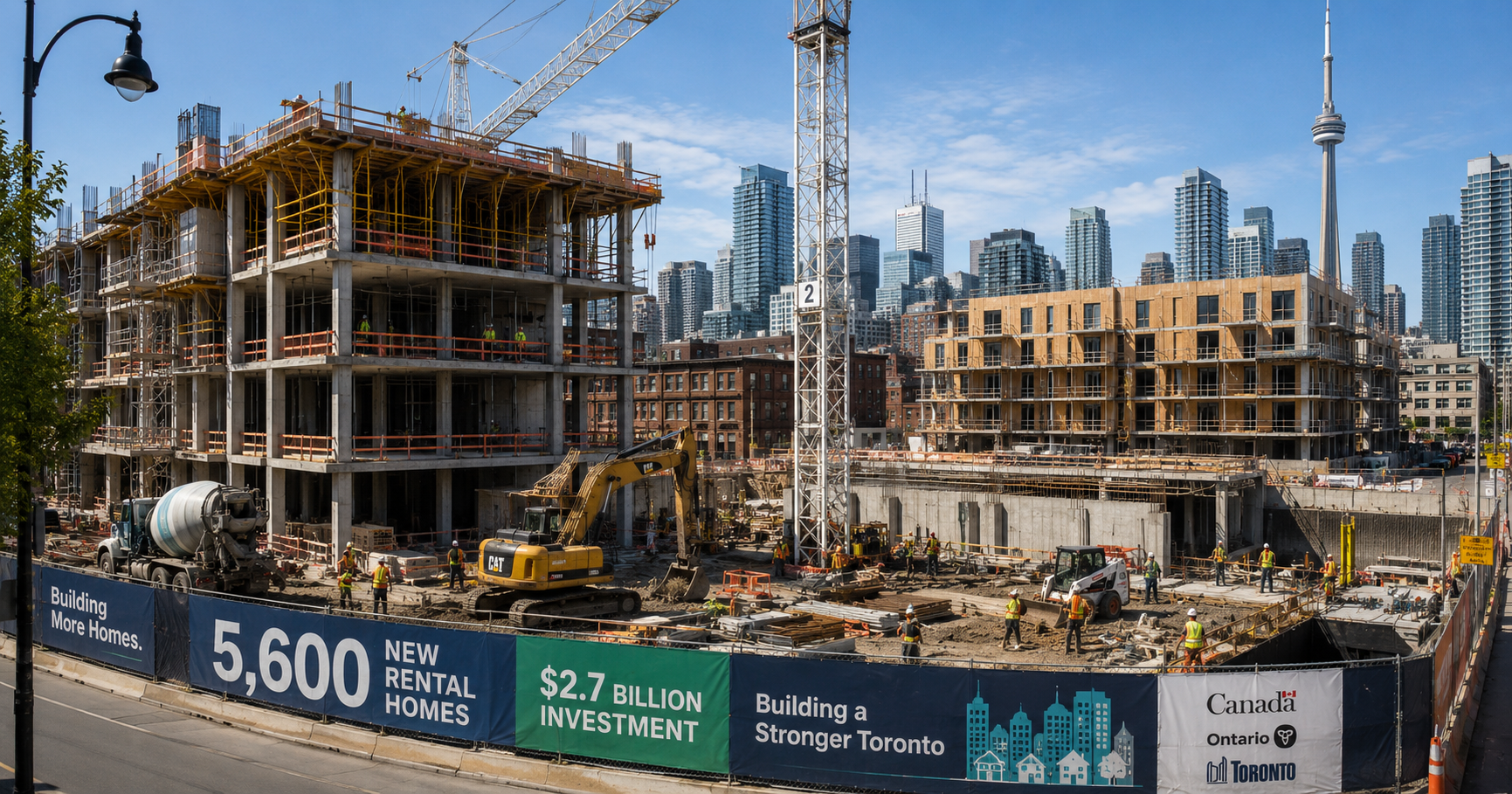
The federal government has announced a $2.7 billion, three-year investment aimed at accelerating construction of more than 18 housing projects across Toronto. Together, the developments are expected to deliver approximately 5,600 rental homes, creating a substantial pipeline of residential construction across the city.
Of the total, approximately 1,800 homes are expected to be deeply affordable, supportive, affordable, or rent-controlled. Construction is expected to move quickly, with more than 4,500 homes, representing about 80 percent of the overall program, expected to be under construction by the end of 2026.
The full portfolio is expected to reach substantial completion by March 2031.
Two Funding Streams Will Support Construction
The housing program will move forward through two primary funding channels covering both non-market and private-sector rental development.
The first stream involves more than $310 million through Build Canada Homes to advance nine projects on City of Toronto-owned land.
Those developments are expected to deliver:
- 1,885 rental homes
- Approximately 740 affordable units
- Projects in downtown Toronto, Scarborough, Etobicoke, Parkdale and the waterfront
Toronto is also contributing approximately $530 million, including 99-year exemptions from municipal and school property taxes.
CBC News reports that the second stream will support private-sector rental construction through more than $1.8 billion in federal low-cost financing.
Nine projects under this portion of the program are expected to produce:
- Approximately 3,700 rental homes
- More than 1,000 affordable units
- A combination of market-rate and below-market rental housing
Together, the two programs are intended to move projects into construction while expanding Toronto's long-term rental inventory.
Projects Planned Across Toronto
The 18-project portfolio covers several Toronto neighbourhoods and includes a range of building types and construction approaches.
Among the developments identified is a 16-storey residential project in Parkdale and another development at 158 Borough Drive in Scarborough.
An Indigenous-led development at 15 Denison Avenue will provide approximately 100 homes.
Another project at 1113-1125 Dundas Street West is expected to incorporate mass timber construction, geothermal energy and low-carbon building design. These features could create specialized opportunities for contractors and suppliers experienced in sustainable building systems.
The projects will be built on a combination of city-owned and privately controlled sites, resulting in different procurement, financing and construction requirements across the portfolio.
4,500 Homes Expected to Enter Construction in 2026
One of the most significant aspects of the announcement for the construction industry is the expected pace of development.
More than 4,500 of the approximately 5,600 homes are expected to be under construction before the end of 2026.
That schedule means multiple projects could be progressing simultaneously through permitting, site preparation, excavation, foundations, structural construction and building systems installation.
With the entire portfolio targeted for substantial completion by March 2031, contractors will be working across a multi-year construction pipeline rather than on a single development.
Construction Trades Involved
With projects ranging from conventional rental buildings to mass timber and low-carbon developments, the program is expected to require a broad range of construction trades, including:
- Excavation and site preparation contractors
- Concrete and foundation contractors
- Structural steel and framing crews
- Mass timber contractors and installers
- Mechanical, electrical and plumbing contractors
- HVAC and geothermal system specialists
- Roofing and waterproofing contractors
- Window, glazing and building-envelope contractors
- Elevator installers
- Drywall, flooring, painting and interior finishing trades
- Landscaping and sitework contractors
Suppliers of concrete, steel, lumber, mass timber components, windows, mechanical equipment, electrical systems, plumbing products and interior finishes could also see opportunities as individual developments advance.
A Major Toronto Residential Construction Pipeline
The $2.7 billion federal commitment represents a substantial pipeline of rental construction spread across Toronto. Rather than relying on one development model, the initiative combines publicly supported non-market housing with private-sector rental projects backed by federal financing.
For contractors, subcontractors and suppliers, the most important number may be the 4,500 homes expected to be under construction by the end of 2026. With more than 18 developments moving through the pipeline and completion extending through 2031, the program could generate construction opportunities across numerous building stages and specialties.
As individual projects move into procurement and construction, watching for tender packages, contractor appointments and subcontracting opportunities will be essential for construction companies looking to participate in Toronto's next major wave of rental housing development.
Judy Lamelza
Editor-in-Chief